Published on 5 min read By Granja Natura
Why choose a farm school for your school trip near Barcelona
Why a farm school trip is a smart educational investment: hands-on learning, curriculum links and over 30 animal species at Granja Natura in Navàs, Barcelona.
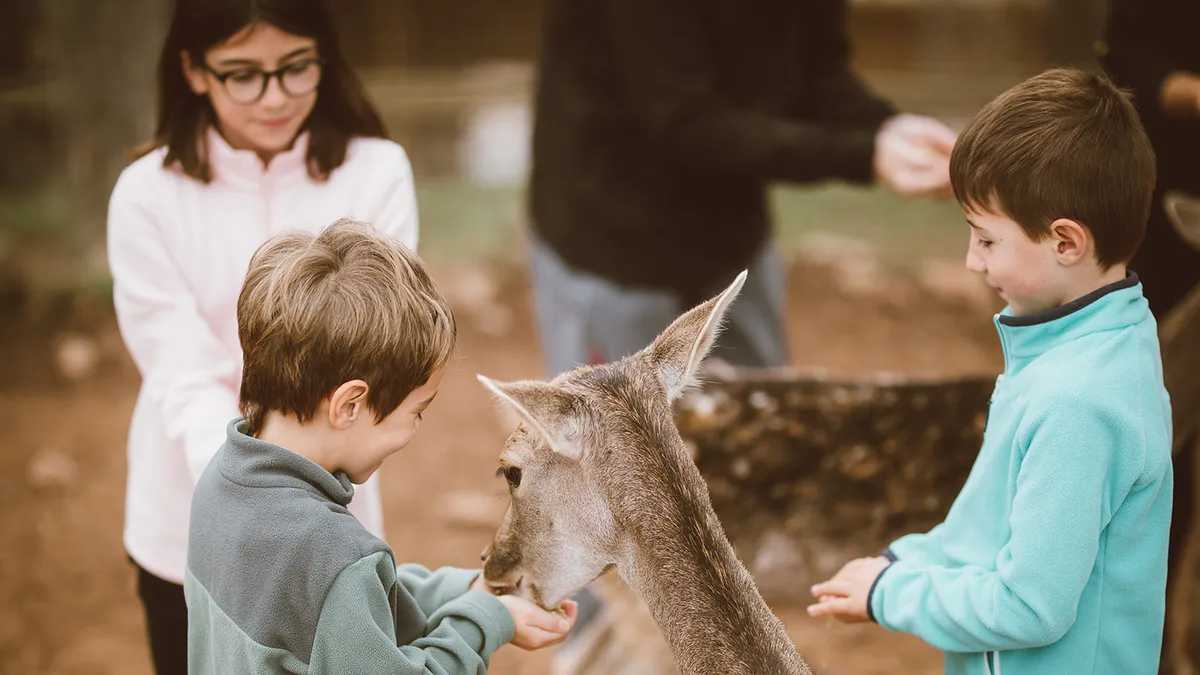
School trips to educational farms are one of the highest-return investments a school can make. Direct contact with animals, nature and rural life creates experiential learning that a classroom can rarely replicate. At Granja Natura (CAN, Centre d’Apropament a la Natura), in Navàs, around 80 km and one hour from Barcelona, school groups find programs designed for every stage, from P3 through upper secondary and vocational studies.
This article is not a price list: it is a guide for teachers who want to understand why a farm trip is worth it, what students work on and how it fits the curriculum. If you are looking for the practical details and booking, you will find them on the school activities page.
Experiential learning: why it is worth the investment
Farm schools offer a learning environment that combines environmental education, animal contact and outdoor activity. When a student touches the wool of a sheep, watches a Harris eagle fly or discovers why a tortoise lives so long, concepts stop being abstract and stick in a way that a textbook cannot match.
On a school visit to the farm, students:
- Observe and interact with farm animals, exotic species and birds of prey in a safe, supervised setting
- Understand biodiversity, ecosystems and food chains through real examples
- Develop empathy and respect for living beings
- Connect curriculum content with first-hand experiences
- Spend a full day outdoors, away from screens
Curriculum alignment: what students learn
Programs are designed to fit the curriculum of the Catalan Department of Education. The areas covered include:
| Curricular area | Content covered | Stage |
|---|---|---|
| Natural Environment Knowledge | Living beings, habitats, food chains, life cycles | Early years and primary |
| Natural Sciences | Biodiversity, ecosystems, adaptations, animal classification | Primary and secondary |
| Values Education | Respect for animals, sustainability, responsibility | All |
| Mathematics | Counting, measurement, estimation woven into the activities | Early years and primary |
| Language | Specific vocabulary, oral expression, post-visit writing | All |
After the day, each school receives a pedagogical report and educational worksheets to continue the work in class and consolidate what the trip taught.
Much more than science: emotional development
A farm trip does not only cover science content. Caring for an animal, waiting your turn to feed it or patiently observing a behaviour all help build responsibility, calm and teamwork. For many students it is the first real contact with a living animal that is not a pet, and that experience leaves a mark.
The benefits of these visits for children range from better attention to stronger positive bonds with the natural world.
Programs adapted to each stage
Programs are adapted from early years through upper secondary and vocational studies. Each stage has its own focus and per-student price; accompanying teachers and monitors enter free.
- Early years (P3-P5): first sensory contact with the animals, with supervised contact with rabbits, chickens, African goats and tortoises, and discovery of sounds, smells and textures. 10.50 EUR per student.
- Primary: a full guided tour with farm animals, exotic species (iguanas, snakes and more) and birds of prey (barn owl, eagle owl and Harris eagle), plus hands-on workshops suited to the age group. 11.50 EUR per student.
- Secondary, upper secondary and vocational: a more scientific, critical approach, observing species from the angle of conservation and animal welfare, with research workshops. 12.50 EUR per student.
What a full day looks like
School visits are full-day, Monday to Friday, from 10:00 to 16:00. A typical day combines:
- A guided tour of the different farm zones with a specialist monitor
- Supervised interaction with the animals, adapted to the group’s age
- Lunch in the covered picnic area, with a barbecue service available
- Afternoon workshops on the animals and nature
Large groups split into smaller subgroups that rotate through the activities, so the experience always stays close and hands-on. The farm hosts a maximum of around 60 students at once.
Practical information for teachers
How to get there
Granja Natura is in Navàs, in the heart of the Bages region, around 80 km and one hour from Barcelona. Access is via the C-16, exit 71 (Navàs Sud). The final stretch is a dirt track suitable for cars but not for coaches, so it is worth checking group access options in advance. You will find all the details on how to get here.
Timetable and season
- School visits: Monday to Friday, 10:00 to 16:00
- Busiest seasons: spring (April to June) and autumn (October and November). If you want these dates, book early.
Prices and booking
- Early years (P3-P5): 10.50 EUR per student
- Primary: 11.50 EUR per student
- Secondary, upper secondary and vocational: 12.50 EUR per student
- Accompanying teachers and monitors: free
Bookings are made directly online on the website, at least two weeks in advance.
School trips to a farm school are an experience students remember for years and that keeps paying off in the classroom long after the visit. With over 30 species of rescued animals, programs for every stage and teaching materials to use in class, Granja Natura is a go-to destination for schools in Barcelona and central Catalonia. Explore the school programs and book your visit to bring nature into your classroom.
Frequently asked questions
How much does a school trip to Granja Natura cost?
The price per student is 10.50 EUR for early years (P3-P5), 11.50 EUR for primary and 12.50 EUR for secondary and upper secondary. Accompanying teachers and monitors enter free.
What ages do you accept for school trips?
Granja Natura welcomes school groups from P3 (age 3) through upper secondary and vocational studies. Each stage has a program with activities and content adapted to the students' level.
How long does a school visit to the farm last?
School visits are full-day, Monday to Friday, from 10:00 to 16:00. The day combines a guided tour, animal interaction, lunch in the picnic area and afternoon workshops.
How do we book a school trip to Granja Natura?
Bookings are made directly online on the website, at granjanatura.com/en/book, at least two weeks in advance. Spring and autumn are the busiest seasons.
Are the activities aligned with the school curriculum?
Yes. Granja Natura designs its programs following the competencies of Catalonia's Environmental Knowledge curriculum. Each school receives a pedagogical report and educational worksheets to continue the work in class.
Related articles
-
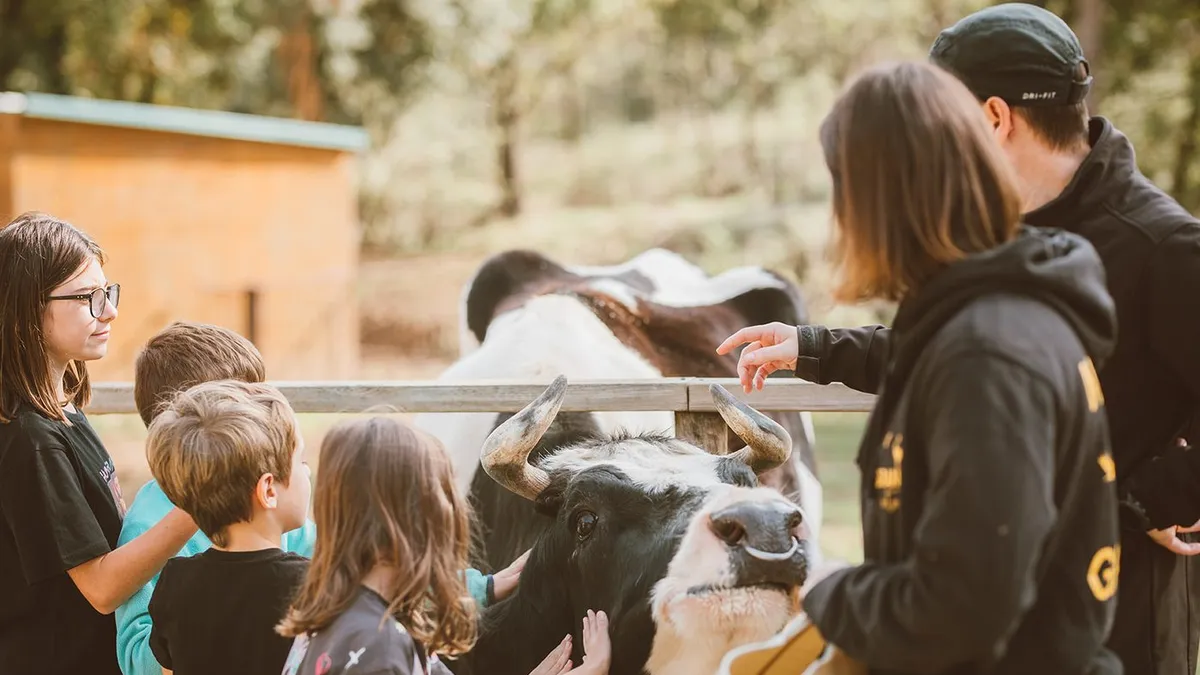
10 benefits of farm school visits for children
Discover why educational farm visits are one of the best activities for children. From animal contact to environmental education, farm schools near Barcelona offer unforgettable experiences.
-
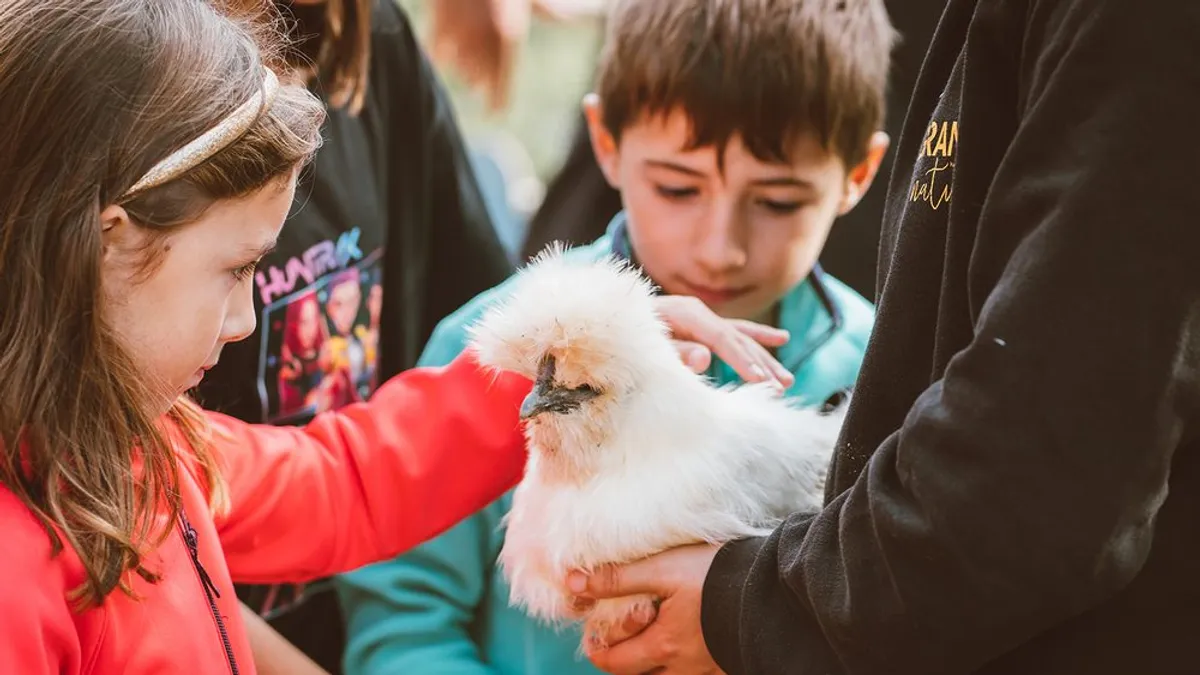
Farm animals: educational guide for kids (chickens, goats and more)
Discover the characteristics, fun facts and care of chickens, goats, rabbits and ducks. An educational guide for kids who want to learn about farm animals with real data and hands-on activities.