Published on 8 min read By Granja Natura
Mediterranean forest animals: complete guide to Catalonia's wildlife
Discover the animals living in Catalonia's Mediterranean forests: wild boars, roe deer, foxes, raptors and more. A complete guide with habitats, behaviour and fascinating facts.
The Mediterranean forests of Catalonia are one of the richest and most diverse ecosystems in Europe. From the coast of the Maresme to the mountain ranges of the Bages, from the Montseny massif to the Gavarres hills, our woodlands harbour a fascinating wildlife that many visitors, and even locals, are unaware of. At Granja Natura (Navas, Barcelona province), located in the heart of Central Catalonia, we are surrounded by this ecosystem and one of our missions is to raise awareness of the wild animals that inhabit our forests.
What is the Mediterranean forest?
The Mediterranean forest is a biome that develops in regions with a Mediterranean climate: hot, dry summers, mild winters and rainfall concentrated in autumn and spring. In Catalonia, this ecosystem covers most of the territory, from sea level up to 800-1,000 metres altitude.
Characteristic vegetation
- Trees: Holm oak (Quercus ilex), Aleppo pine (Pinus halepensis), downy oak (Quercus pubescens), cork oak (Quercus suber)
- Shrubs: Heather (Erica), mastic tree (Pistacia lentiscus), rosemary (Rosmarinus officinalis), thyme (Thymus vulgaris)
- Lianas and herbs: Wild asparagus, smilax, honeysuckle
This vegetation provides food, shelter and habitat for hundreds of animal species.
Mammals of the Mediterranean forest
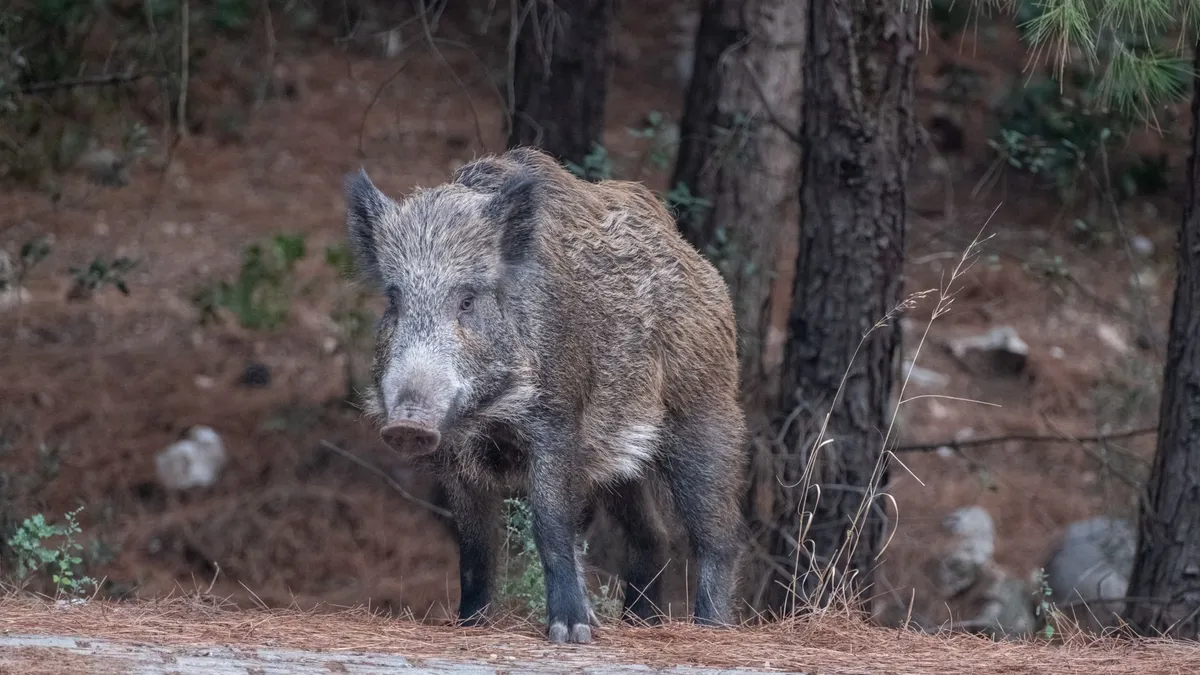
Wild boar (Sus scrofa)
The wild boar is probably the most iconic mammal of the Catalan forests and the one that most frequently interacts with people, particularly in peri-urban areas.
- Size: 90-160 cm in length, 55-110 kg (adult males)
- Diet: Omnivorous, acorns, roots, tubers, insects, small vertebrates, carrion
- Behaviour: Nocturnal and crepuscular. Females live in family groups; adult males are solitary
- Reproduction: 1-2 litters per year, with 4-8 piglets per litter
- Fun fact: They can run at 40 km/h and are excellent swimmers
- Catalan population: Estimated at over 200,000, and growing steadily
The wild boar has adapted so well to urban areas that sightings in residential neighbourhoods of Barcelona and around the Collserola park are now commonplace. This coexistence creates conflicts but also opportunities for environmental education.
Roe deer (Capreolus capreolus)
The roe deer is Europe’s smallest deer and one of the most graceful animals in our forests.
- Size: 60-75 cm tall, 15-30 kg
- Diet: Herbivorous, shoots, leaves, grass, wild berries
- Behaviour: Solitary or in small family groups. Very shy and difficult to spot
- Reproduction: Mating takes place in July-August. The doe has 1-2 fawns in May-June, with a remarkable feature: delayed implantation (the embryo does not begin developing until December)
- Fun fact: Fawns are born with a spotted coat that camouflages them perfectly among vegetation. The mother leaves them alone for hours while she forages, this is completely normal and does not mean they are abandoned
- Catalan population: Expanding thanks to forest recovery
Fox (Vulpes vulpes)
The red fox is the most common and adaptable wild carnivore in Europe.
- Size: 50-90 cm body + 30-55 cm tail, 4-8 kg
- Diet: Opportunistic, rodents, rabbits, birds, insects, fruit, urban waste
- Behaviour: Mainly nocturnal and crepuscular. Territorial, with underground dens
- Reproduction: 4-6 cubs in March-April
- Fun fact: It has exceptional hearing, it can detect a mouse beneath snow from 5 metres away
Badger (Meles meles)
The Eurasian badger is one of the most secretive mammals in our forests.
- Size: 60-90 cm body, 8-15 kg
- Diet: Omnivorous, earthworms, insects, fruit, tubers, small vertebrates
- Behaviour: Strictly nocturnal. Lives in complex setts with multiple entrances that may be occupied for generations
- Fun fact: It is one of the few European mammals that semi-hibernates in winter, it does not sleep continuously but markedly reduces activity
Hedgehog (Erinaceus europaeus)
The hedgehog is one of the best-loved yet increasingly threatened animals in our gardens and forests.
- Size: 20-30 cm, 800 g - 1.5 kg
- Diet: Insectivorous, snails, slugs, beetles, caterpillars
- Behaviour: Nocturnal. Hibernates from November to March
- Threats: Road kills, pesticides, habitat loss, garden netting and traps
- Fun fact: It has around 7,000 spines and, when threatened, rolls into a ball that is virtually impenetrable
Red squirrel (Sciurus vulgaris)
The red squirrel is one of the few forest mammals that is easily observed during the day.
- Size: 20-25 cm body + 15-20 cm tail, 250-350 g
- Diet: Pine nuts, walnuts, hazelnuts, acorns, mushrooms, shoots
- Behaviour: Diurnal and arboreal. Builds spherical nests (dreys) in tree branches
- Fun fact: It buries food stores for winter but forgets the location of some, thereby helping to regenerate the forest
Beech marten (Martes foina)
- Size: 40-55 cm body, 1-2 kg
- Diet: Omnivorous, fruit, rodents, birds, eggs, insects
- Behaviour: Nocturnal and very agile. Has adapted well to rural and peri-urban environments
- Fun fact: Notorious for chewing car cables, one of the most “troublesome” species in human settings
Birds of the Mediterranean forest
Diurnal raptors
Birds of prey are the aerial predators of the Mediterranean forest. At Granja Natura you can see several raptor species up close during our guided visits.
- Northern goshawk (Accipiter gentilis): The great hunter of the forest. Flies between trees at high speed to catch birds and squirrels
- Common buzzard (Buteo buteo): The most common raptor in Catalonia. Easy to spot soaring in circles over open areas
- Booted eagle (Hieraaetus pennatus): Migratory, present in Catalonia from March to October
- Eurasian sparrowhawk (Accipiter nisus): Small but fierce hunter of woodland birds
Nocturnal raptors
- Eurasian eagle-owl (Bubo bubo): The largest nocturnal raptor in Europe, wingspan up to 1.80 m
- Little owl (Athene noctua): Small and characterful, often associated with farmhouses and rural buildings
- Tawny owl (Strix aluco): The most common nocturnal raptor in Catalan forests. Its call (“hoo-hooo”) is the signature sound of a night in the woods
- Eurasian scops owl (Otus scops): The smallest of Catalonia’s nocturnal raptors. Migratory, present in summer
In the afternoon workshop you can meet birds of prey up close, even fly a Harris’s hawk or a barn owl yourself, and understand their ecological role as regulators of rodent and other animal populations.
Other woodland birds
- European robin (Erithacus rubecula): One of the most popular and easy-to-spot birds, present in our forests year-round
- Eurasian jay (Garrulus glandarius): An intelligent, noisy bird that buries acorns and helps expand holm-oak woodland
- European green woodpecker (Picus viridis): Its characteristic drumming on tree trunks is a familiar forest sound
- Common cuckoo (Cuculus canorus): Famous for laying its eggs in other species’ nests (brood parasitism)
- Barn swallow (Hirundo rustica): Migratory, announcing spring with its return in March
Reptiles and amphibians
Reptiles
- Common wall lizard (Podarcis liolepis): The most common reptile in Catalonia. Easily spotted basking on rocks and walls
- Iberian wall lizard (Podarcis hispanicus): Smaller than the above, found in drier areas
- Western whip snake (Hierophis viridiflavus): Non-venomous, can reach 2 metres. Very beneficial for rodent control
- Asp viper (Vipera aspis): The only venomous reptile in Catalan forests. Not aggressive, bites only in self-defence
- Mediterranean tortoise (Testudo hermanni): Endangered, found in the Albera Massif and the Gavarres
Amphibians
- Common frog (Pelophylax perezi): Found in pools, fountains and streams
- Midwife toad (Alytes obstetricans): The male carries the eggs wrapped around his hind legs until they hatch
- Marbled newt (Triturus marmoratus): Inhabits forest pools and springs
- Fire salamander (Salamandra salamandra): Nocturnal species associated with humid forests. Its striking yellow-and-black colouring is a warning of toxicity
The Mediterranean forest through the seasons
Spring (March - June)
Spring is the season of peak activity in the forest:
- Return of migratory birds (swallows, cuckoos, booted eagles)
- Birth of young (roe deer, foxes, wild boar)
- Plants flower and insects boom
- Birdsong is at its loudest
Summer (July - September)
Summer is the period of highest wildfire risk:
- Many animals reduce daytime activity (heat)
- Nights become the peak activity period
- Young raptors take their first flights
- Caution: Do not light fires, do not discard cigarettes, observe access restrictions
Autumn (October - December)
Autumn is the Mediterranean’s second spring:
- Roe deer rutting season
- Wild boar begin preparing for winter
- Mushrooms and wild fruits attract many species
- Wintering birds arrive
Winter (January - March)
Winter is the resting period:
- Hedgehogs, reptiles and amphibians hibernate
- Wild boar are more active during the day to make the most of warmer hours
- Nocturnal raptors are easier to hear
- Bare deciduous trees reveal nests and shelters
Tips for observing wildlife in the Mediterranean forest
- Go at the right times: Dusk and dawn are the best moments
- Be quiet: Walk in silence, stop often and listen
- Wear subtle clothing: Neutral colours, avoid bright hues
- Binoculars: Essential for observing birds and mammals at a distance
- Field guide: Carry a species-identification guide
- Respect: Do not approach animals, do not touch nests or young, do not leave litter
- Track-reading: Learning to identify footprints, droppings and tracks is every bit as thrilling as seeing the animal itself
Discover Mediterranean wildlife at Granja Natura
At Granja Natura (Navas, Barcelona province) you can meet Mediterranean wildlife species up close during our guided visits. Our guides will share fascinating facts about each species and teach you to identify the animals of the forest. With over 30 animal species, including native birds of prey, it is the perfect starting point for discovering the captivating wildlife of the Mediterranean forest.
Book your visit to Granja Natura and immerse yourself in the world of Mediterranean forest animals.
Frequently asked questions
What animals can you find in the forests of Catalonia?
Catalonia's Mediterranean forests are home to a great diversity: mammals such as wild boar, roe deer, fox, badger, hedgehog and red squirrel; raptors such as the goshawk, common buzzard and eagle-owl; reptiles such as the common wall lizard and the western whip snake; and amphibians such as the common frog and the midwife toad. Biodiversity varies with altitude and forest type.
Where can I see Mediterranean forest animals up close?
At Granja Natura (Navas, Barcelona province) you can meet Mediterranean wildlife species during guided visits, including native birds of prey. To spot wildlife in its natural habitat, the best times are dusk and the early morning, when animals are most active.
Are wild boars dangerous?
Wild boars normally avoid human contact and flee if they detect us. They can be dangerous if cornered, injured, or if a sow is protecting her piglets. If you encounter wild boars in the forest, keep your distance, do not run, and make gentle noise to alert them to your presence.
Why is it important to conserve the Mediterranean forest?
The Mediterranean forest is one of Europe's most biodiverse ecosystems, but also one of the most threatened. Forest fires, urbanisation, climate change and invasive species endanger an ecological balance that has taken thousands of years to form. Conserving it means protecting hundreds of animal and plant species.
What can I do to help conserve Mediterranean forest wildlife?
Stay on marked trails, do not leave litter in the forest, do not light fires outside designated areas, do not disturb animals or touch young, take part in environmental volunteering, and educate children about nature by visiting centres like Granja Natura.
Related articles
-
Native animals in danger of extinction in Catalonia and Spain
From the Iberian lynx to the Pyrenean bearded vulture, discover native species in danger of extinction in Catalonia and Spain: threats, conservation programmes and how you can help.
-
What to do if you find an injured animal: protocol in Catalonia
Found an injured animal in the countryside or in town? Learn the correct protocol in Catalonia: what to do, who to call, and how to act without endangering the animal or yourself.